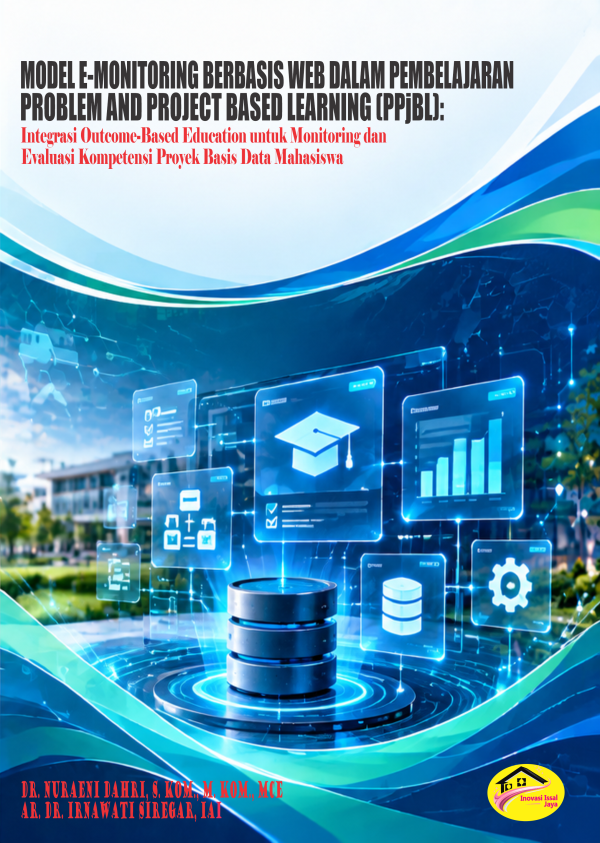
Model E-Monitoring Berbasis Web dalam Pembelajaran Problem and Project Based Learning (PPjBL): integrasi outcome-based education untuk monitoring dan evaluasi kompetensi proyek basis data mahasiswa
Keywords:
Model E-Monitoring Berbasis Web, Problem and Project Based Learning (PPjBL)Synopsis
Monograf ini membahas model e-monitoring berbasis web untuk pembelajaran Problem and Project Based Learning (PPjBL) yang berorientasi pada Outcome-Based Education (OBE), khususnya dalam pengembangan kompetensi proyek Basis Data. Uraian meliputi landasan konseptual, arsitektur, pengelolaan proses lima fase, bukti kompetensi, penghitungan kontribusi individu, reviu dosen, serta mekanisme penilaian akhir. Penekanan diberikan pada keterlacakan antara capaian pembelajaran, aktivitas mahasiswa, artefak proyek, dan keputusan asesmen yang dapat ditinjau kembali.
Model memperkenalkan pengelolaan tiket berbasis Kanban, validasi prasyarat, penilaian sejawat, Indeks Kontribusi Individu, dan indikator peringatan dini untuk mendukung pendampingan. Pembahasan juga menjelaskan batasan parameter yang masih memerlukan validasi, pengamanan data, keadilan penilaian, dan strategi adopsi. Buku ini ditujukan kepada dosen, pengembang pembelajaran digital, mahasiswa pendidikan informatika, dan pengelola institusi yang membutuhkan kerangka konseptual untuk memantau kompetensi dalam pembelajaran proyek secara bertanggung jawab.
Editor : Dr. Muhammad Ihsan, S.PdI., M.Kom
Halaman : i-x + 86 halaman
Ukuran : 17,6 x 25 cm (B5)
Harga : Rp
ISBN : 978-634-05-8754-8
Beli : -
References
Biggs, J. (1996). Enhancing teaching through constructive alignment. Higher Education, 32, 347–364. https://doi.org/10.1007/BF00138871
Dahri, N., & Mallisza, D. (2024). Effectiveness of problem-based and project-based learning models in achieving competencies in database learning. International Journal of Multidisciplinary Research of Higher Education, 7(3), 206–213. https://doi.org/10.24036/ijmurhica.v7i3.255
Fleckney, P., Thompson, J., & Vaz-Serra, P. (2025). Designing effective peer assessment processes in higher education: A systematic review. Higher Education Research & Development, 44(2), 386–401. https://doi.org/10.1080/07294360.2024.2407083
Guo, P., Saab, N., Post, L. S., & Admiraal, W. (2020). A review of project-based learning in higher education: Student outcomes and measures. International Journal of Educational Research, 102, 101586. https://doi.org/10.1016/j.ijer.2020.101586
Hmelo-Silver, C. E. (2004). Problem-based learning: What and how do students learn? Educational Psychology Review, 16, 235–266. https://doi.org/10.1023/B:EDPR.0000034022.16470.f3
Jisc. (2015, updated 2026). Code of practice for learning analytics. https://www.jisc.ac.uk/guides/code-of-practice-for-learning-analytics
Kaliisa, R., Jivet, I., & Prinsloo, P. (2023). A checklist to guide the planning, designing, implementation, and evaluation of learning analytics dashboards. International Journal of Educational Technology in Higher Education, 20, Article 28. https://doi.org/10.1186/s41239-023-00394-6
Li, M., & Rohayati, M. I. (2024). The relationship between learning outcomes and graduate competences: The chain-mediating roles of project-based learning and assessment strategies. Sustainability, 16(14), 6080. https://doi.org/10.3390/su16146080
Mallisza, D., Dahri, N., & Yahyan, W. (2024). E-monitoring model design for junior high school students to strengthen the Pancasila charracters. Journal of Scientech Research and Development, 6(2), 871–879. https://doi.org/10.56670/jsrd.v6i2.848
Nicol, D. J., & Macfarlane-Dick, D. (2006). Formative assessment and self-regulated learning: A model and seven principles of good feedback practice. Studies in Higher Education, 31(2), 199–218. https://doi.org/10.1080/03075070600572090
Paulsen, L., & Lindsay, E. (2024). Learning analytics dashboards are increasingly becoming about learning and not just analytics—A systematic review. Education and Information Technologies, 29, 14279–14308. https://doi.org/10.1007/s10639-023-12401-4
Thiagarajan, S., Semmel, D. S., & Semmel, M. I. (1974). Instructional development for training teachers of exceptional children: A sourcebook. Leadership Training Institute/Special Education, University of Minnesota. https://eric.ed.gov/?id=ED090725
Topping, K. J. (2009). Peer assessment. Theory Into Practice, 48(1), 20–27. https://d
oi.org/10.1080/00405840802577569
Tumpa, R. J., Skaik, S., Ham, M., & Chaudhry, G. (2022). A holistic overview of studies to improve group-based assessments in higher education: A systematic literature review. Sustainability, 14(15), 9638. https://doi.org/10.3390/su14159638
UNESCO. (2023). Global education monitoring report 2023: Technology in education—A tool on whose terms? UNESCO. https://www.unesco.org/gem-report/en/publication/technology