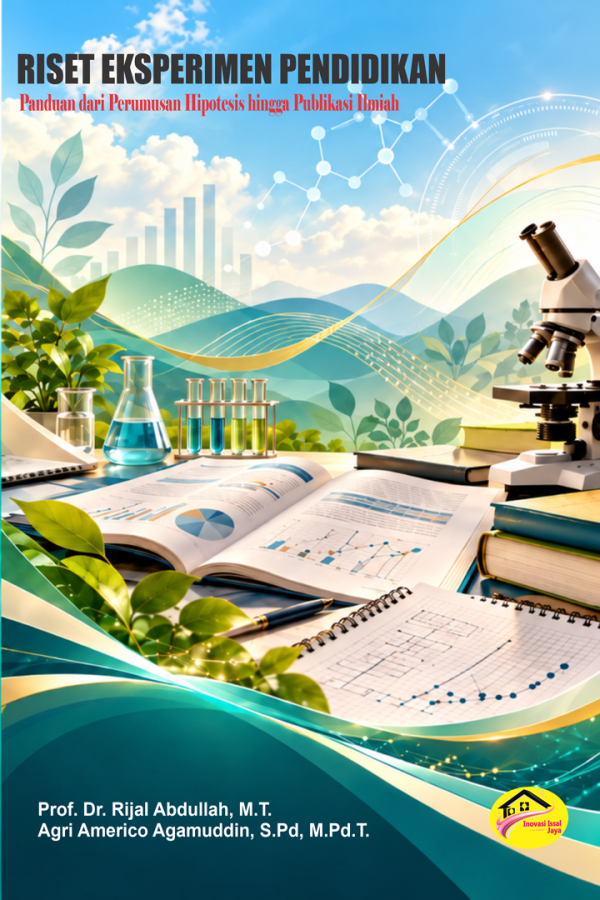
RISET EKSPERIMEN PENDIDIKAN: Panduan dari Perumusan Hipotesis hingga Publikasi Ilmiah
Keywords:
RISET EKSPERIMEN PENDIDIKAN, Perumusan Hipotesis, Publikasi IlmiaSynopsis
Riset eksperimen bukan sekadar kegiatan membandingkan kelompok atau menghitung perbedaan rerata. Ia adalah rangkaian penalaran yang menyatukan pertanyaan ilmiah, teori, intervensi, kontrol, pengukuran, dan interpretasi. Kekuatan pendekatan ini terletak pada kemampuannya menguji dugaan melalui perubahan yang direncanakan, tetapi kekuatan tersebut hanya dapat dipertahankan apabila peneliti bersedia menjelaskan asumsi, keterbatasan, dan keputusan yang membentuk data.
Dalam pendidikan teknik dan kejuruan, eksperimen menyediakan peluang menguji inovasi pembelajaran di tengah perubahan teknologi, kebutuhan industri, serta keragaman kondisi lembaga. Namun, keberhasilan inovasi tidak boleh disimpulkan hanya karena media atau model tertentu tampak modern. Dampak pada kompetensi, kemampuan bernalar, keselamatan, dan keberlanjutan belajar perlu diuji menggunakan pembanding yang sesuai dan instrumen yang relevan. Hasil yang tidak mendukung hipotesis tetap dapat bernilai ketika memberikan informasi tentang kondisi penerapan atau batas suatu pendekatan.
Buku ini mengarahkan peneliti untuk menempatkan transparansi sebagai fondasi. Perlakuan harus dapat ditelusuri; alokasi peserta harus dijelaskan; instrumen dan data perlu dipertanggungjawabkan; analisis harus menyesuaikan desain; dan publikasi harus menyatakan hasil sebagaimana adanya. Melalui prinsip itu, penelitian tidak hanya menyelesaikan kewajiban akademik, tetapi juga dapat menjadi sumber pengetahuan yang berguna bagi peneliti lain, pendidik, dan pengambil keputusan.
Editor : Muhammad Hifni, M.Pd
Halaman : i-xii + 176 halaman
Ukuran : 17,6 x 25 cm (B5)
Harga : Rp
ISBN : 978-634-05-7711-2
Beli : -
References
Billot, L., Copas, A., Leyrat, C., Forbes, A., & Turner, E. L. (2024). How should a cluster randomized trial be analyzed? Journal of Epidemiology and Population Health, 72(1), Article 202196. https://doi.org/10.1016/j.jeph.2024.202196
Boateng, G. O., Neilands, T. B., Frongillo, E. A., Melgar-Quiñonez, H. R., & Young, S. L. (2018). Best practices for developing and validating scales for health, social, and behavioral research: A primer. Frontiers in Public Health, 6, Article 149. https://doi.org/10.3389/fpubh.2018.00149
Chan, A.-W., Boutron, I., Hopewell, S., Moher, D., Schulz, K. F., Collins, G. S., et al. (2025). SPIRIT 2025 statement: Updated guideline for protocols of randomised trials. BMJ, 389, e081477. https://doi.org/10.1136/bmj-2024-081477
Flake, J. K., & Fried, E. I. (2020). Measurement schmeasurement: Questionable measurement practices and how to avoid them. Advances in Methods and Practices in Psychological Science, 3(4), 456–465. https://doi.org/10.1177/2515245920952393
Freeman, S., Eddy, S. L., McDonough, M., Smith, M. K., Okoroafor, N., Jordt, H., & Wenderoth, M. P. (2014). Active learning increases student performance in science, engineering, and mathematics. Proceedings of the National Academy of Sciences, 111(23), 8410–8415. https://doi.org/10.1073/pnas.1319030111
Funder, D. C., & Ozer, D. J. (2019). Evaluating effect size in psychological research: Sense and nonsense. Advances in Methods and Practices in Psychological Science, 2(2), 156–168. https://doi.org/10.1177/2515245919847202
Hattie, J., & Timperley, H. (2007). The power of feedback. Review of Educational Research, 77(1), 81–112. https://doi.org/10.3102/003465430298487
Hemming, K., & Taljaard, M. (2023). Key considerations for designing, conducting and analysing a cluster randomized trial. International Journal of Epidemiology, 52(5), 1648–1658. https://doi.org/10.1093/ije/dyad064
Hoffmann, T. C., Glasziou, P. P., Boutron, I., Milne, R., Perera, R., Moher, D., et al. (2014). Better reporting of interventions: Template for intervention description and replication (TIDieR) checklist and guide. BMJ, 348, g1687. https://doi.org/10.1136/bmj.g1687
Hopewell, S., Chan, A.-W., Collins, G. S., Hróbjartsson, A., Moher, D., Schulz, K. F., et al. (2025). CONSORT 2025 statement: Updated guideline for reporting randomised trials. BMJ, 389, e081123. https://doi.org/10.1136/bmj-2024-081123
Lakens, D. (2022). Sample size justification. Collabra: Psychology, 8(1), Article 33267. https://doi.org/10.1525/collabra.33267
Lin, H.-M., Wu, J.-Y., Liang, J.-C., Lee, Y.-H., Huang, P.-C., Kwok, O.-M., & Tsai, C.-C. (2023). A review of using multilevel modeling in e-learning research. Computers & Education, 198, Article 104762. https://doi.org/10.1016/j.compedu.2023.104762
Page, M. J., McKenzie, J. E., Bossuyt, P. M., Boutron, I., Hoffmann, T. C., Mulrow, C. D., et al. (2021). The PRISMA 2020 statement: An updated guideline for reporting systematic reviews. BMJ, 372, n71. https://doi.org/10.1136/bmj.n71
Serrano-Mendizábal, M., Villalón, R., Melero, Á., & Izquierdo-Magaldi, B. (2023). Effects of two computer-based interventions on reading comprehension: Does strategy instruction matter? Computers & Education, 196, Article 104727. https://doi.org/10.1016/j.compedu.2023.104727